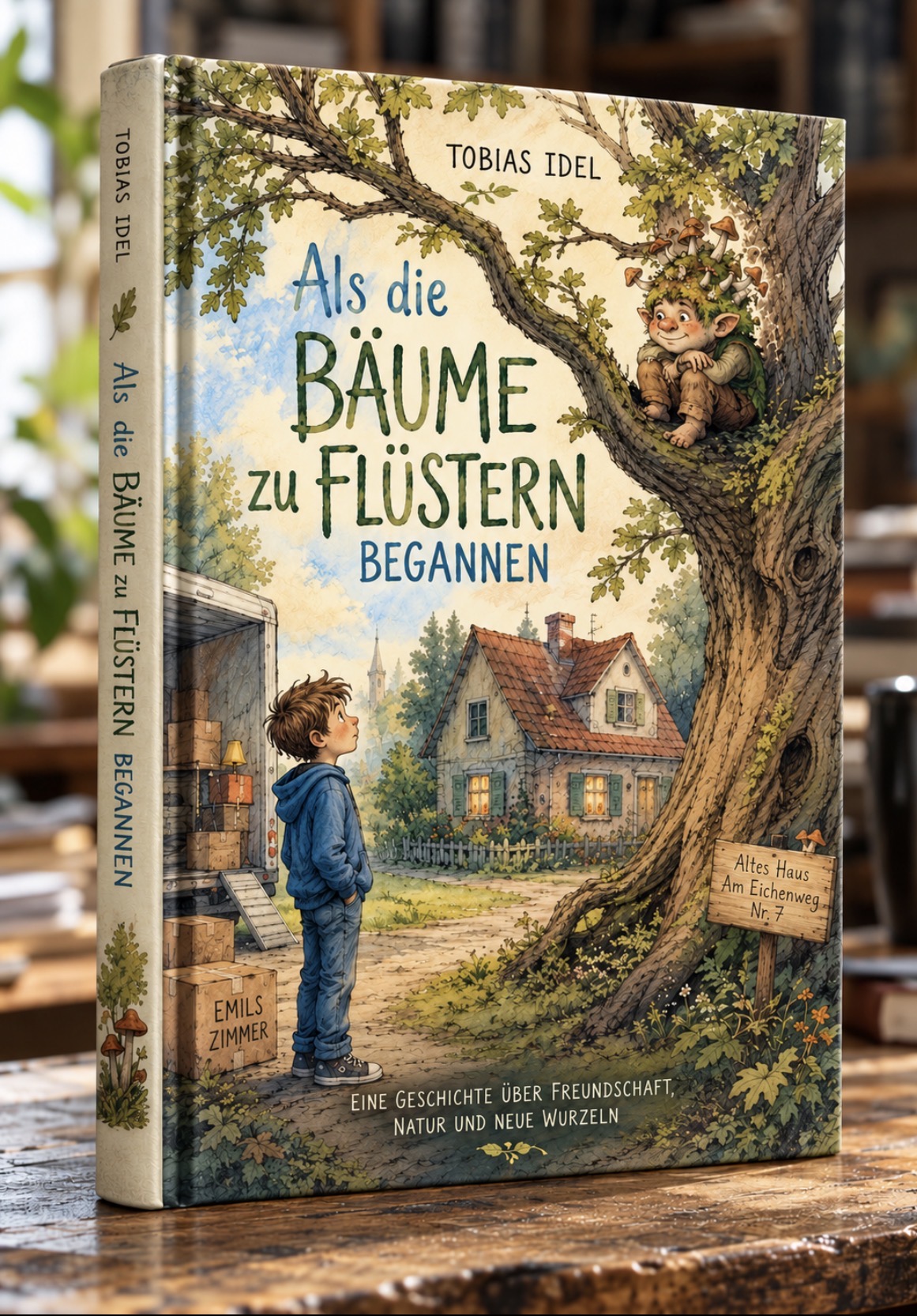
When we reached Farnwinkel, our removal van had barely travelled a hundred metres before it got stuck between a stone fountain and a tractor. On the left, there was scarcely a hand’s width between the van and the fountain wall. On the right, the tractor’s front tyre jutted into the road, with two cars already waiting behind it. Within minutes, nine people were standing at the roadside watching. Ten if you counted the woman behind the curtain, and eleven with the dog outside the grocery shop, who looked at least as curious as everyone else.
“Here we are,” Mum said.
She probably meant it as good news. I pushed my glasses up and looked at the village sign beside us. Farnwinkel, it said in black letters. Beneath them was a green sticker with a cockerel someone had given a moustache.
“Doesn’t look as if we’re getting any further today,” I said.
Mum gave me a quick glance before turning back to the removal van. “It’ll be all right.”
She had been saying that about almost everything for three weeks. The unpacked boxes, the new school, her late uncle’s house, and even Dad, when I asked how often I would get to see him now. “It’ll be all right” was a sentence that could hold all sorts of things. Just never a proper answer.
Ahead of us, the removal driver sounded his horn. The tractor honked back, and a large man in wellington boots climbed down from the seat. He had broad shoulders and a pale strip across his forehead, as though he normally wore a cap there. He strode over to the van and knocked on the driver’s door.
“You won’t get through there,” he called.
The driver leaned out of the window. “I can see that for myself.”
“Then you’ll have to reverse.”
“There’s a car behind me.”
Now every onlooker turned towards us. I slid a little lower in my seat and pretended to be reading something important on my phone. There was no message. Dad had promised to get in touch as soon as we reached Farnwinkel, but perhaps we would only count as having arrived once we stopped blocking the village road.
That morning, I had still known where I belonged. I knew the houses on our old street, which fence hid the dog that barked loudly but never bit, and which paving slab outside the bakery wobbled if you stepped on its left corner. Dad’s flat had been only twelve minutes away by bike. Now there were a hundred and thirty-two kilometres between us, and a man standing in front of our car apparently already thought we were in the way.
Mum opened her door. “Wait a moment, Emil.”
She went over to the two men and tried to work something out. The tractor man pointed at the fountain, the removal driver pointed at the tractor, and Mum pointed at the space behind it. For a while they all talked at once. Then the man in wellingtons shook his head, climbed back up and reversed a little. It was not much, but it was enough. The van edged past the fountain wall, one tyre scraping over the kerb. The woman behind the curtain clapped a hand over her mouth as though there had just been an accident.
The tractor rolled alongside our car. The man leaned down towards Mum and asked, “Where are you heading with all that stuff?”
“Eichenweg. My uncle’s house.”
His gaze moved to me and lingered on my glasses. “The old house beneath the oak?”
Mum nodded. “That’s the one.”
“Ah.”
He said nothing else at first, but I did not like the way he looked towards the end of the road. It was the same look grown-ups gave a door they knew would stick.
“I’m Paula,” Mum said. “And this is Emil.”
“Alfred.” The man straightened up. Apparently there was only one Alfred in Farnwinkel, which made a surname unnecessary. “The track up there’s pretty overgrown. If the van gets through, it’ll have to take it slowly.”
He did not sound unfriendly. It was more like a warning. Mum thanked him, and Alfred raised a hand before driving off on his tractor. He left a brown cloud of dust that smelled of warm earth, diesel and a little bit of cowshed.
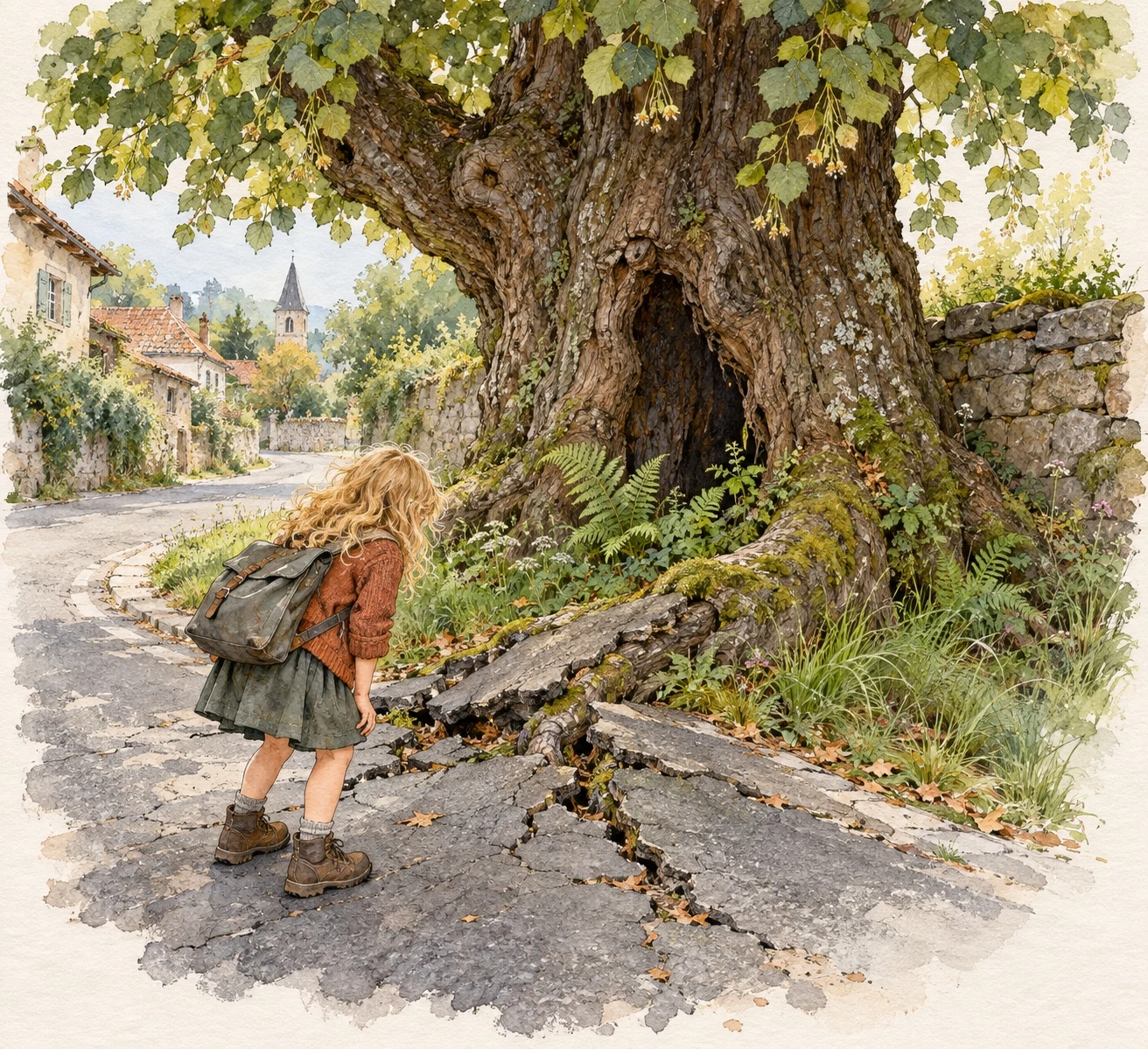
We followed the removal van through the village. Beyond the fountain came a church, an inn and a bus stop. A sign outside the town hall read: Farnwinkel in Bloom! Underneath it, though, there was only a dandelion growing out of a crack in the paving. Further on, the houses thinned out and a stream appeared beside the road. There were chickens in a meadow. One raised its head and watched our car until we vanished round a bend.
“I expect word of our arrival will spread quickly here,” Mum said.
“It already has.” I pointed behind us. “Even the chicken knows.”
Mum actually laughed, but a moment later the track became so narrow that she tightened both hands on the steering wheel. Eichenweg was nothing more than two worn ruts with grass down the middle. Branches brushed the removal van’s roof, and the driver went more and more slowly. For a moment I hoped this track would be too narrow as well. Then we would have to turn round, drive back past the fountain and the eleven spectators, and perhaps just carry on all the way to our old flat.
But the van got through.
The house appeared beyond the next bend. It was smaller than in the photographs Mum had shown me. The roof sagged a little on one side. Two shutters were green, one was brown, and the fourth window had no shutter at all. Creeper reached up to the gutter, while the garden was so overgrown that only patches of the gravel path to the front door were visible.
Then I saw the oak.
It did not simply stand behind the house. It was too big for that, and looked far too old. It was more as though someone had built the house in front of the oak long ago without daring to get too close. Its trunk was wider than our car. Roots rose from the ground, disappeared into the grass and surfaced somewhere else. One branch stretched over the roof. It was so thick that I could not tell whether it was protecting the house or waiting to bury it one day.
The removal van stopped with a hiss of brakes. Mum switched off the engine but stayed in her seat. She looked at the house, then at the oak. She no longer seemed as certain as she had over the past few weeks whenever she talked about our fresh start.
“Here we are,” she said quietly.
I did not ask whether she was sad. When grown-ups did not want you to notice something, they usually said they were tired. Mum had been tired a lot lately.
When I got out, the air smelled of damp earth, leaves and old wood. We could hardly hear the village here. Only the stream murmuring somewhere beyond the garden, and the removal men pulling out the van’s ramp with a metallic clatter.
The garden gate hung crookedly between two posts. Mum lifted it so it would not drag along the ground and said, “Uncle always meant to fix this.”
He had actually been my great-uncle, but everyone in our family had simply called him Uncle. I had barely known him and could remember only two visits. On the second, he had given me a magnifying glass and explained that you only noticed important things if you looked closely enough. At the time, I had thought he meant beetles and leaves.
“It’s still holding,” Mum said, pushing the gate open.
We had barely stepped through when the top hinge came loose. The gate tipped slowly sideways and landed in the long grass.
Mum watched it fall. “Or perhaps not.”
We both had to laugh, and for a few seconds moving here felt less awful. Then the front door stuck. Mum turned the long key left and right, pressed her shoulder against the wood and muttered something I was not supposed to hear.
“Maybe the house doesn’t want us,” I said.
“The house wasn’t asked.”
“Neither was I.”
Mum stopped pushing. For a moment she stood with her shoulder against the door and looked at me. I wished I could take the words back, not because they were wrong, but because they had hurt her.
“I know,” she said at last.
Before I could answer, the door gave way with a jerk. Dust swirled out of the hall. Mum stumbled over the threshold and coughed. Inside, it was cool. It smelled of old wood, dust and something sweet that reminded me of apples left too long in a bowl.
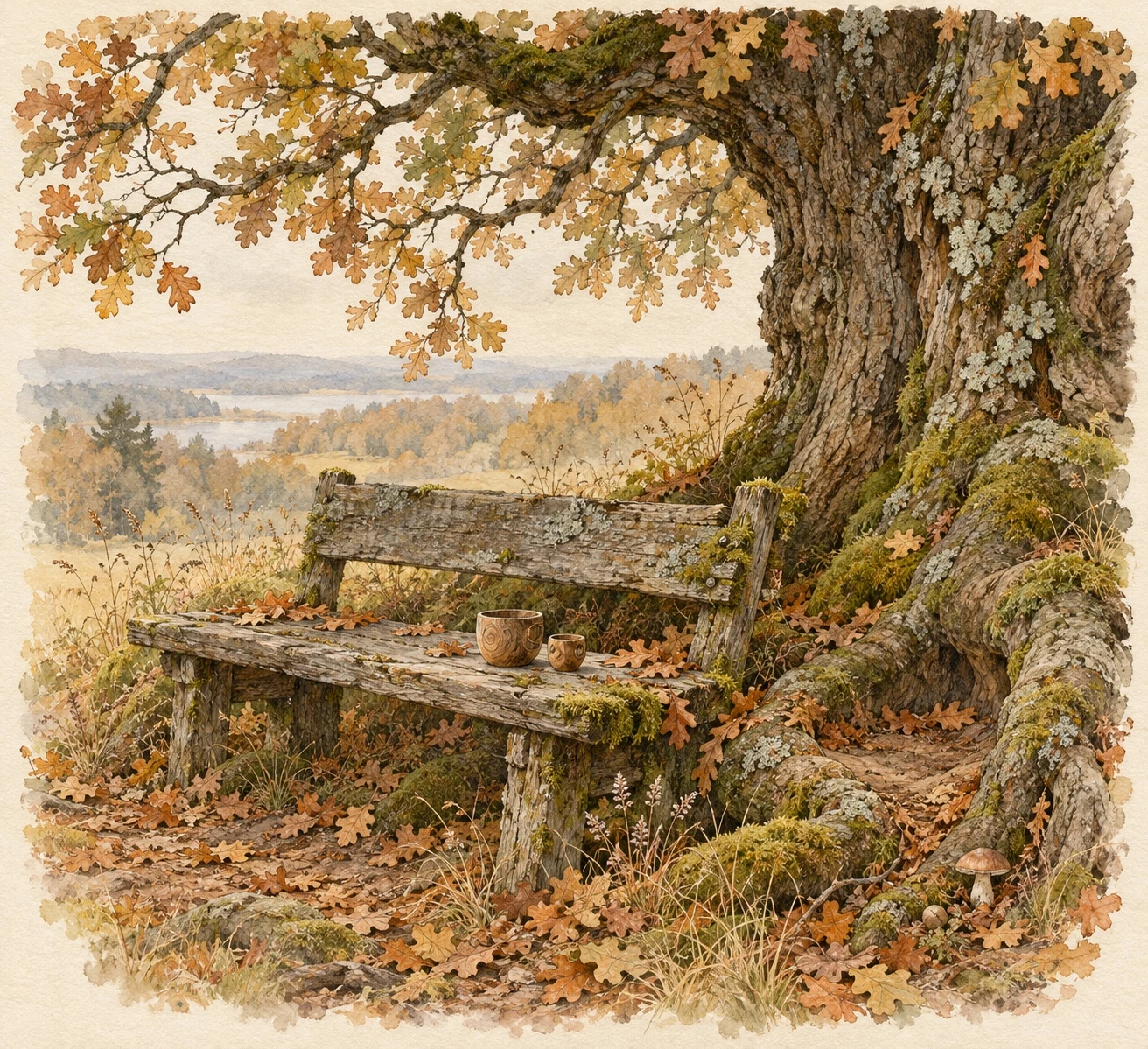
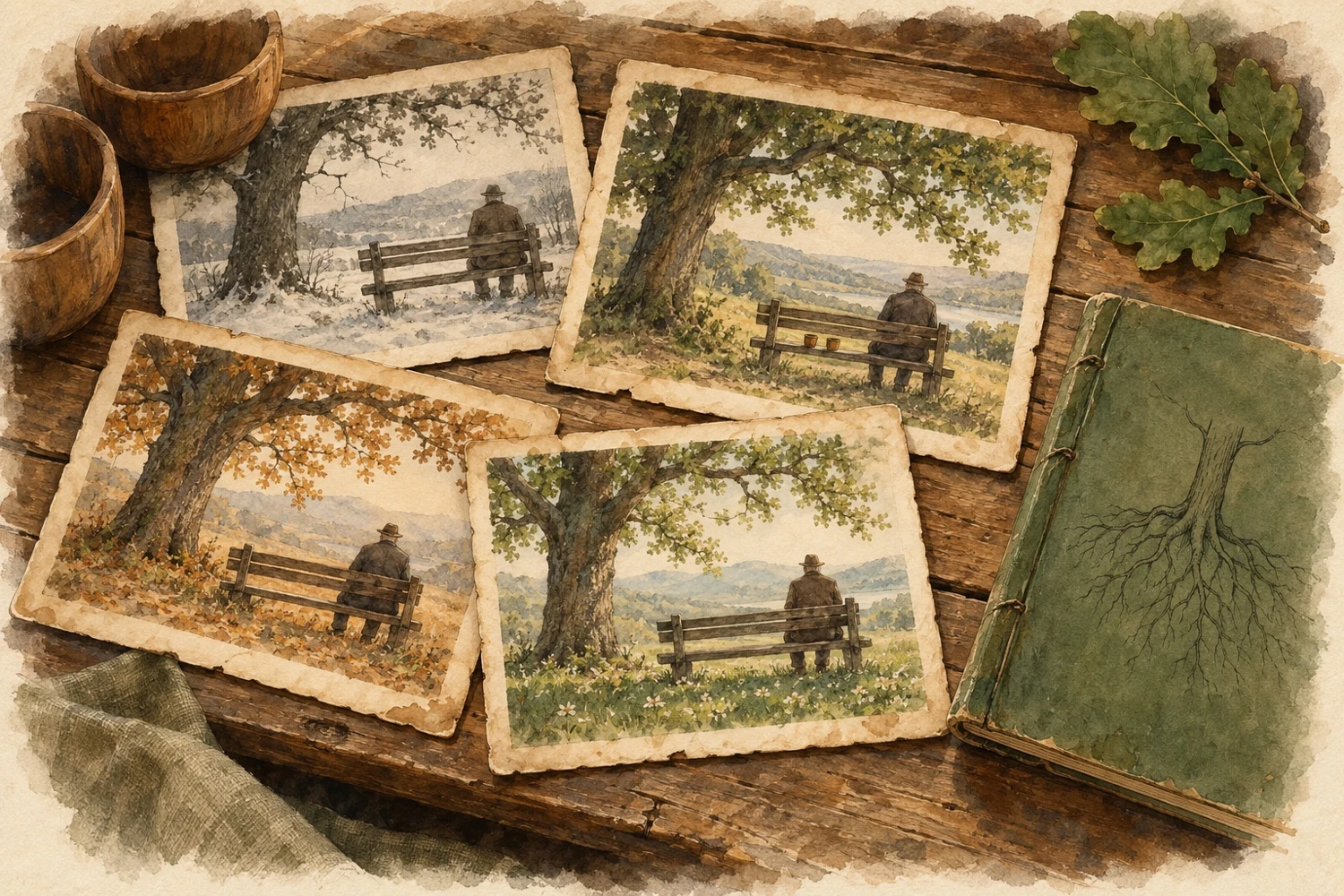
The floorboards creaked with every step. Pictures of the village and the church hung on the walls, and picture after picture of the oak. There it was in summer, in snow, in rain, and once without a single leaf. A photograph of Uncle stood on a narrow chest of drawers. He was sitting on a bench beneath the tree, wearing a jacket far too big for him. Two small wooden cups rested on his knees.
There was no one beside him.
Yet Uncle was not looking at the camera. His head was turned towards a low branch, his mouth open, as though the photographer had caught him in the middle of a conversation.
“Mum, who’s he talking to?”
She came in with a bag, set it beside the stairs and took the frame from my hands. “Maybe the tree.”
She said it so calmly that at first I thought I had misheard. “The oak?”
“He often sat beneath it.”
I pointed to the two cups. “Did it get a drink as well?”
Mum smiled, but her eyes stayed sad. “The second one must have been for the photographer.”
“But he was standing in front of him.”
“Then it was for later.” She put the photograph back and straightened it a little. “There are two rooms upstairs. Choose one before the men bring up the beds.”
The stairs creaked as I climbed. After the fourth step, I heard another creak behind me. I stopped and turned, but there was no one there. Only when I lifted my foot again did the wood groan a second time, slowly and drawn out, as though someone behind me were taking their weight off a step.
I called for Mum. Her answer came at once from the hall below, so I only said it was nothing.
The first room was small and bright. From its window I could see the track and the removal van. In the second, an old bed frame still stood against the wall. The oak’s branches hung so close to the window that their leaves turned the light green. A thin twig lay against the pane, brushing slowly across it.
I moved closer. Not a leaf was stirring outside, yet the twig scraped across the glass again. In the garden, the removal men were carrying Mum’s desk into the house. There was no one else to be seen.
“I’ll take this one,” I called downstairs.
The room was bigger, and I told myself that was the only reason I had chosen it. The truth was, I wanted to know how a twig could move when there was no wind.
The rest of the day passed among furniture and moving boxes. Some were labelled correctly, others were not. A box marked BATHROOM held cables and two odd shoes, while we eventually found the plates among my books. Mum blamed the removal company, even though I recognised her handwriting on the tape.
That afternoon, I was carrying my desk lamp through the garden when something hit my forehead. An acorn bounced off my head and landed in the grass. I rubbed the sore patch and looked up into the crown of the tree. There was no bird or squirrel to be seen among the leaves.
The acorn was bigger than the ones in our old town park. On one side it had a dark mark like a screwed-up eye. I turned it between my fingers and said, “Very funny.”
Two knocks came from inside the trunk.
I went closer and laid my hand on the bark. It felt rough and warm. The knocking did not come again. After a while Mum called from the house because she was looking for the plates. I slipped the acorn into my trouser pocket and went back to her.
That evening, we ate pasta on two upturned boxes. My bed was already assembled, but the wardrobe door would only stay shut if you put a beer mat under the left side. The mat showed a pig wearing sunglasses, which did nothing for the wardrobe’s looks but at least made it useful.
“What do you think?” Mum asked.
I knew she did not mean the wardrobe. I looked at its crooked door and said, “It suits the house.”
“That’s not an answer.”
“It is for today.”
Mum nodded and asked no more questions. I was grateful for that.
Later, I lay in my new bed and listened to the house. Water rushed through old pipes. Somewhere, wood cracked. Something ticked inside the wall, though we had not put up a clock yet. Sometimes a floorboard creaked out in the hall, then another, as though someone were slowly approaching my door. When I switched on the light, there was nothing there.
Just before ten, my phone lit up. Dad had sent a message.
Arrived safely? I’ll be in touch tomorrow. Proud of you.
I read it twice and replied: Yes. The house is crooked. Then I waited for the little ticks beside my message to turn blue. They stayed grey.
When I put down the phone, I remembered the acorn. It was still in the pocket of my trousers, which hung over the bedpost. I took it out, opened the window and threw it into the garden.
“Good night,” I said to the oak. “And stop knocking.”
The moment I said it, I felt silly. It was only a tree. I closed the window, lay down and pulled the duvet up to my chin.
Everything stayed quiet for a long time. Then the twig tapped against the pane. Once, twice, three times.
I sat up. Moonlight lay on the leaves outside the window, but not one of them moved. Slowly, the twig lifted away from the glass. At the same time, something began scratching inside the wall behind my bed.
I held my breath.
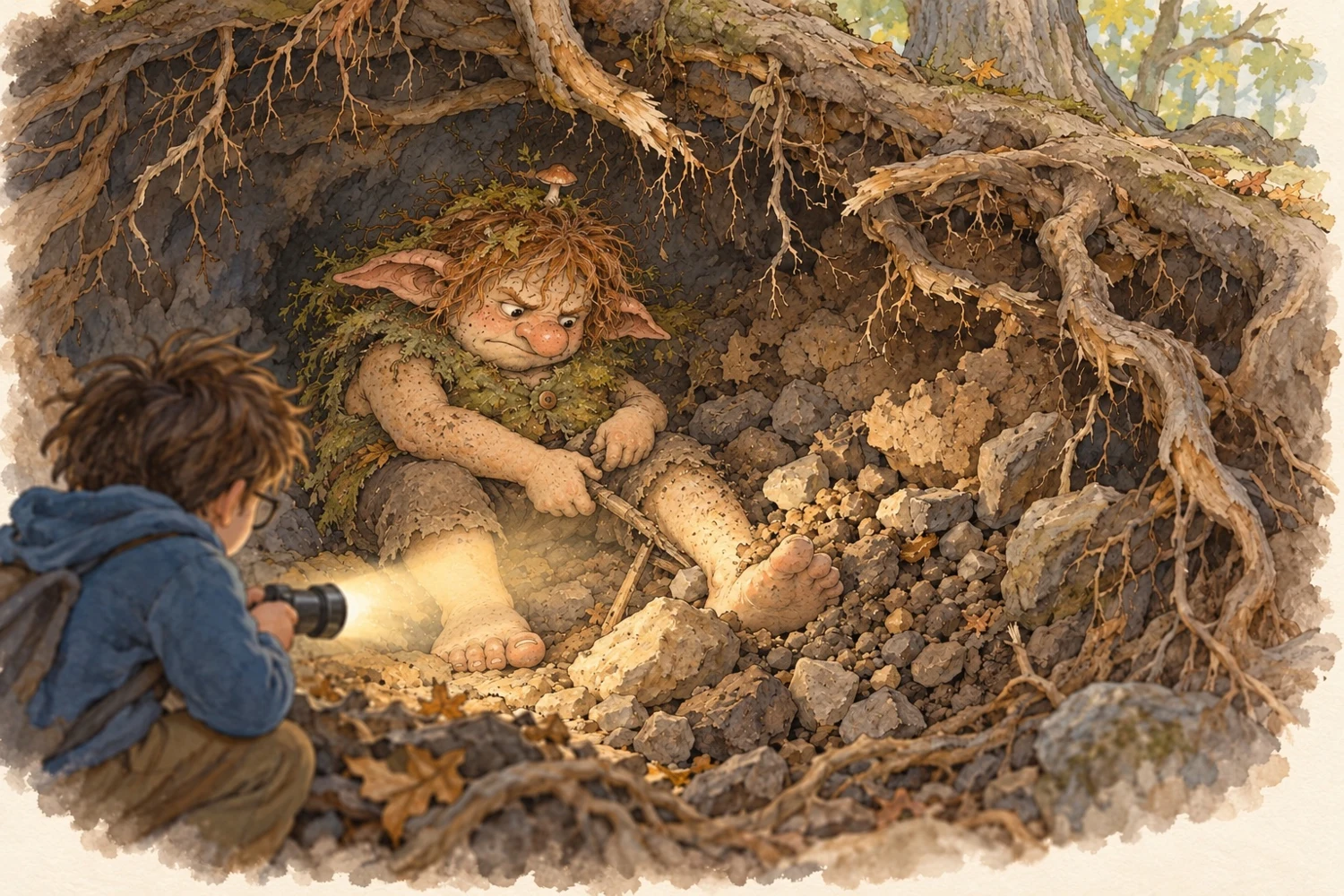
Someone cleared their throat. Softly, hoarsely and in a distinctly bad temper.
Then a voice spoke directly behind me:
“At last.”